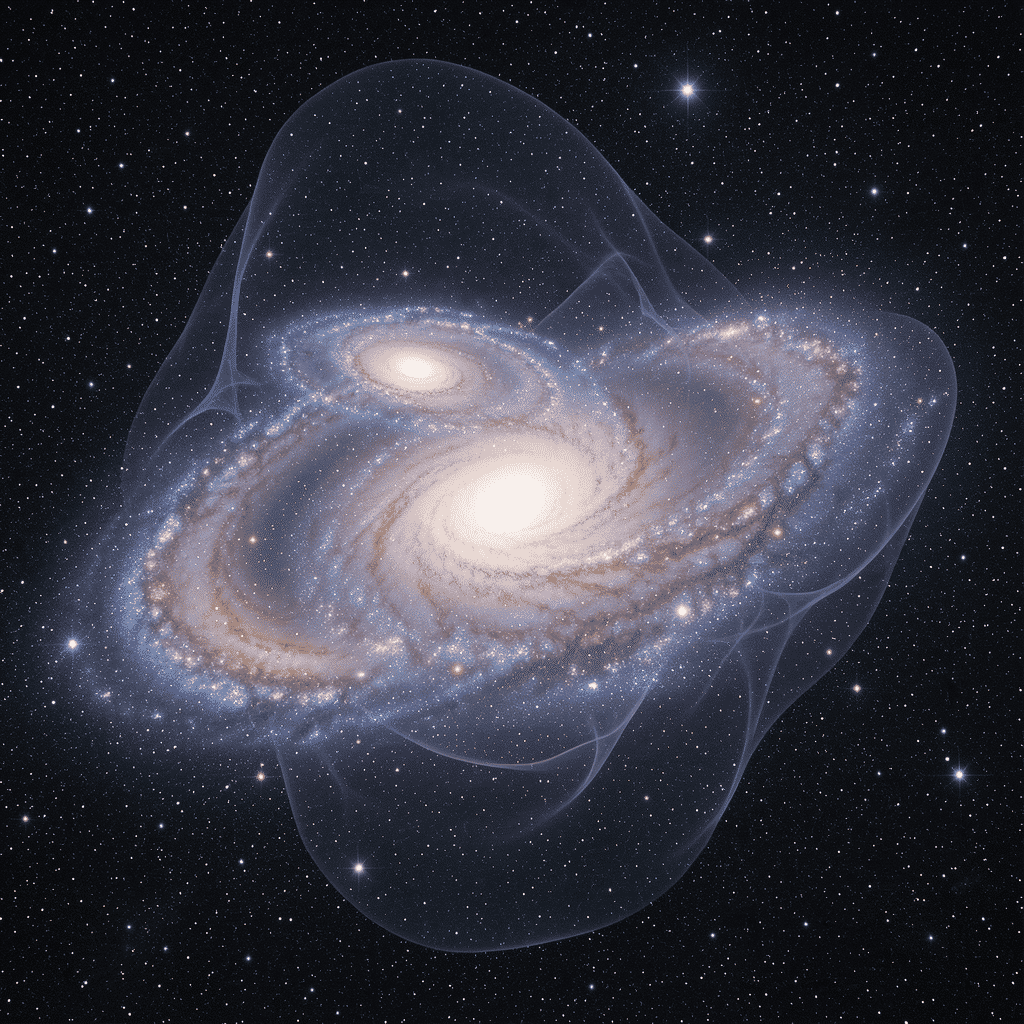
In the dimly lit corridors of cosmic mystery, dark matter holds a particularly enigmatic position. Though it constitutes approximately 27% of the universe, its elusive nature has kept scientists on a relentless quest for understanding. However, recent findings from Spectrum Gmr Pep Sciences might be turning the tide, offering a fresh perspective that challenges the status quo and propels our exploration of the cosmos into uncharted territories.
Traditionally, dark matter has been characterized by its invisible and intangible properties. Unobservable directly, its presence has been inferred solely through gravitational effects on visible matter, such as stars and galaxies. This has left scientists with a perplexing puzzle: how can something so central to the universe remain so hidden? But now, researchers at Spectrum Gmr Pep have managed to illuminate new aspects of this cosmic phenomenon.
In a series of unprecedented experiments, Spectrum Gmr Pep Sciences employed advanced telescopic technologies and particle detectors to gather data on dark matter interactions. These sophisticated instruments have achieved a level of sensitivity and precision previously unattainable, allowing researchers to observe subtle perturbations and unveil a smorgasbord of faint cosmic signals. The analytical leap has sparked discussions about the possibility of dark matter having more complex interactions than previously thought.
One of the revolutionary insights from this research is the proposition that dark matter might interact with itself in peculiar ways. By analyzing the patterns of dark matter distribution in galaxy clusters, the team noticed anomalies that suggest some form of self-interaction. This challenges existing models, where dark matter is often viewed as a cold, non-interacting substance. If proven, this could revise our fundamental understanding of the particle physics governing the universe.
Furthermore, the implications for space exploration are profound. Understanding the nuances of dark matter could aid in the refinement of cosmic maps, making distant parts of the universe more accessible to scientific study. The potential for new propulsion methods or navigational technologies based on the manipulation or harnessing of dark matter's properties is a notion ripe for exploration.
The Spectrum Gmr Pep team's discoveries also encourage a multidisciplinary approach, initiating collaborations between astrophysicists, quantum theorists, and engineers, each bringing their expertise to unravel this cosmic mystery. Such partnerships could usher in a new era of innovation, potentially revolutionizing how we study and inhabit space.
Despite these advancements, the universe still holds its secrets tightly. Yet, with each discovery, we are a step closer to comprehending the celestial dance of matter and energy. As we continue to probe into the vast unknown, the findings from Spectrum Gmr Pep serve as a beacon, lighting the way toward a deeper understanding of our universe and possibly revealing the fabric underpinning existence itself. As researchers dive deeper into the mysteries of dark matter, we are reminded of the endless curiosity that drives human exploration, pushing the boundaries of knowledge and imagination further into the cosmos.